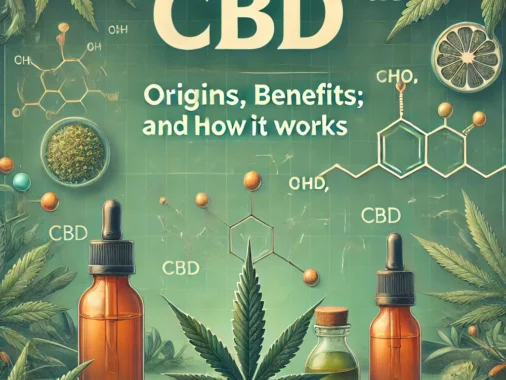
Why does the CBD molecular structure matter so much? Because a molecule’s shape controls how it behaves—how it dissolves, how it breaks down, and how it interacts with receptors. In this guide, you’ll learn what cannabidiol looks like at the atomic level and why its structure makes it distinct from THC and other cannabinoids.
What Is the CBD Molecular Structure?
Cannabidiol (CBD) is a plant-derived organic molecule with the molecular formula C21H30O2 and a molecular weight of about 314.46 g/mol. It is a neutral, non-intoxicating phytochemical found in hemp and cannabis.
At-a-glance identity
- IUPAC name: 2-[(1R,6R)-6-isopropenyl-3-methylcyclohex-2-en-1-yl]-5-pentylbenzene-1,3-diol
- CAS Number: 13956-29-1
- Core features: an aromatic ring with two phenolic OH groups, a five-carbon pentyl side chain, and a terpene-derived cyclohexene moiety
- Chirality: two stereocenters (commonly 1R,6R in natural CBD)
Key structural features that define CBD
- Resorcinol ring: an aromatic ring bearing two hydroxyl (–OH) groups at positions that can donate hydrogen bonds.
- Pentyl chain: a five-carbon tail that increases lipophilicity and helps CBD partition into oils and membranes.
- Terpenoid fragment: a cyclohexene unit with an isopropenyl group, derived from monoterpene biosynthesis.
- Open-chain architecture: unlike THC, CBD lacks the intramolecular ether ring closure, resulting in a more flexible shape.
How the CBD Molecular Structure Differs From THC
CBD and THC are structural isomers—they share the same formula but differ in how atoms are connected. In THC, part of the molecule folds and forms a cyclic ether ring. In CBD, that ring is open, and the phenolic OH groups remain positioned differently in space.
CBD molecular structure vs. THC: Why shape matters
- Open vs. closed ring: CBD’s open structure contributes to low affinity at CB1 receptors relative to THC’s closed pyran ring.
- Hydrogen bonding: CBD’s two phenolic OH groups are more available, which influences solubility and intermolecular interactions.
- Flexibility: CBD’s conformation is more flexible, affecting how it fits into binding sites across the body.
These structural details help explain CBD’s non-intoxicating profile and its different interaction pattern in biological systems without making health claims.
From Plant to Molecule: Biosynthesis and Decarboxylation
In the plant, CBD originates from a biosynthetic pathway that begins with the union of a terpene donor and a polyketide starter. Enzymes in glandular trichomes orchestrate the sequence.
- Geranyl pyrophosphate (GPP) + olivetolic acid → cannabigerolic acid (CBGA).
- CBGA → cannabidiolic acid (CBDA) via CBDA synthase.
- CBDA loses CO2 (decarboxylation) through heat or time → CBD.
Because CBD forms after acid decarboxylation, raw plant material is often richer in CBDA. Heating during extraction or processing completes the conversion to the neutral cbd compound.
Physical and Chemical Properties You Can Use
- Appearance: colorless to pale-yellow crystalline solid (as isolate)
- Melting point: roughly 66–67 °C
- Boiling behavior: decomposes before boiling at 1 atm; reported 180–200 °C under strong vacuum
- Solubility: practically insoluble in water; soluble in oils and organic solvents (ethanol, hexane, MCT)
- LogP: high (lipophilic), commonly reported around 6
- Acidity (pKa): phenolic OH groups in the approximate 9–10 range
- UV absorbance: aromatic system absorbs in the near-UV (around 275–280 nm)
Stability and degradation
- Light and oxygen: can oxidize over time to colored byproducts (e.g., quinones).
- Heat: accelerates oxidation and can promote side reactions if acids are present.
- Acidic conditions: may catalyze isomerization, potentially forming THC-like side products.
Practical storage tips
- Keep CBD in airtight, opaque containers with minimal headspace.
- Store cool and dry; refrigeration helps slow oxidation.
- Avoid acidic additives and strong light exposure during processing.
- Limit repeated heating cycles; warm only as needed for handling.
How to Read a COA: Interpreting the cbd chemical profile
Most reputable brands share a Certificate of Analysis (COA) from an independent lab. Here’s how to decode it quickly.
- Check the identity block: product name, batch/lot number, date tested, and lab accreditation.
- Potency table: confirm CBD percentage or mg/g and verify delta-9 THC is within legal limits.
- Chromatogram: look for a clean CBD peak at expected retention time with minimal unknown peaks.
- cbd chemical profile: review the list of detected species and ensure related species are within expected ranges.
- Purity and contaminants: confirm results for residual solvents, heavy metals, and microbes.
- Stability cues: compare older vs. newer COAs for the same product—rising impurities may indicate oxidation.
If something seems off, request the raw data or method details. Transparent labs are comfortable sharing them.
Common Lab Methods Used to Confirm CBD’s Structure
- HPLC-UV/Diode Array: separates and quantifies CBD and related species without heating the sample.
- GC-MS: powerful identification tool; often requires derivatization to avoid thermal changes in acidic precursors.
- NMR (1H and 13C): confirms the exact carbon–hydrogen framework and functional groups.
- IR spectroscopy: detects O–H and aromatic C=C signals consistent with CBD’s phenolic and aromatic features.
- LC-MS/MS: high sensitivity for trace-level profiling and impurity tracking.
Real-world example: The lesson of “hidden acidity”
Extraction teams sometimes see unexpected shifts in potency. A frequent scenario goes like this:
A hemp oil tests with strong CBD and compliant THC. After winterization in ethanol with a slightly acidic additive, a new test shows a small but real increase in THC. The likely cause? Mild acid-catalyzed isomerization during warm processing.
The fix is simple: neutralize acids, avoid prolonged heating, and re-verify with a third-party COA. Understanding the CBD molecular structure helps teams prevent these avoidable changes.
Applied Chemistry: Step-by-step workflow to protect CBD quality
- Source selection: choose material with transparent farming and testing records.
- Method choice: prefer mild extraction and avoid unnecessary acids during refinement.
- Light and oxygen control: work under low light; use nitrogen or argon to blanket headspace when practical.
- Temperature discipline: keep temperatures as low as your process allows.
- Verification: test early and often—raw, in-process, and final product COAs reduce surprises.
- Documentation: log storage times and conditions; compare chromatograms to track trends.
Where CBD Fits in the Chemical Family Tree
CBD belongs to a family of plant molecules often referred to as cannabinoids. Members share biosynthetic origins but diverge in ring closures, substituents, and stereochemistry, which alter their properties and behavior in analytical tests.
FAQs
What is the molecular formula of CBD?
CBD’s molecular formula is C21H30O2, and its approximate molecular weight is 314.46 g/mol.
How is CBD different from THC at the structural level?
THC contains a closed cyclic ether ring. CBD remains “open,” leaving its two phenolic OH groups and flexible backbone arranged differently in space.
Is CBD water soluble?
No. CBD is highly lipophilic and practically insoluble in water. It dissolves well in oils and organic solvents like ethanol.
Can CBD convert to other compounds?
Under strongly acidic conditions and heat, CBD can isomerize into THC-like compounds. Exposure to oxygen and light can also oxidize CBD over time.
Does heating hemp create CBD?
Heating converts cannabidiolic acid (CBDA) into CBD by removing carbon dioxide, a process called decarboxylation.
Conclusion
The CBD molecular structure—an open, phenolic, lipophilic framework—explains its solubility, stability needs, and analytical behavior. Whether you are a formulator, lab professional, or informed consumer, understanding the basics helps you evaluate quality and protect product integrity.